Burn Gummy Supplement Facts Panel Explained
The Burn Gummy label lists 1 gummy per serving and 30 servings per bottle.
Each gummy has 0 calories, 1 g carbohydrate, 25 mcg chromium as chromium picolinate (71% DV), 40 mg berberine HCl and 28 mg cinnamon bark extract. Berberine and cinnamon have no Daily Value.
Find what each does in the ingredients guide.
What does the Burn Gummy Supplement Facts panel show?
One small box on the bottle holds every fact that matters about the formula.
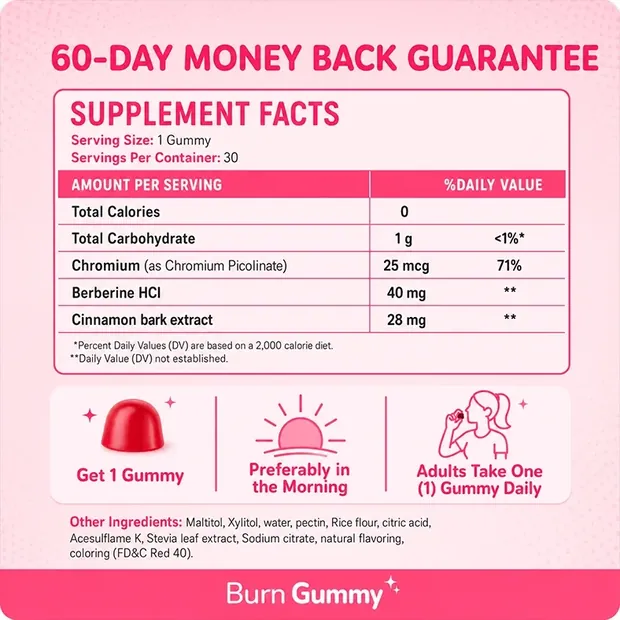
The panel lists five rows of amounts for one gummy. Two are nutrition lines: calories and carbohydrate. Three are the actives: chromium, berberine HCl and cinnamon bark extract.
Below the rows sit two footnotes and the list of other ingredients. That is the whole panel, and every line on it is transcribed below.
The US FDA does not approve supplements before they go on sale (U.S. FDA, Dietary Supplements Q&A). The panel is the maker's own statement of what each gummy holds. That makes it the place to start, not the last word.
Burn Gummy Supplement Facts: every line transcribed
Copied from the label image with the same wording and symbols.
The Burn Gummy Supplement Facts panel, line by line
| Label line | Amount per serving | % Daily Value |
|---|---|---|
| Serving Size | 1 Gummy | No %DV |
| Servings Per Container | 30 | No %DV |
| Total Calories | 0 | Not shown |
| Total Carbohydrate | 1 g | <1%* |
| Chromium (as Chromium Picolinate) | 25 mcg | 71% |
| Berberine HCl | 40 mg | ** |
| Cinnamon bark extract | 28 mg | ** |
- Footnote *
- Percent Daily Values (DV) are based on a 2,000 calorie diet.
- Footnote **
- Daily Value (DV) not established.
- Other ingredients
- Maltitol, Xylitol, water, pectin, Rice flour, citric acid, Acesulfame K, Stevia leaf extract, Sodium citrate, natural flavoring, coloring (FD&C Red 40).
Serving size and servings per container never carry a percentage. The panel also shows no %DV next to calories, which is normal for a supplement label.
The single asterisk on carbohydrate points to the 2,000 calorie footnote. The double asterisk on berberine and cinnamon points to the second footnote.
The actives are covered in depth on the Burn Gummy ingredients page. This page sticks to how to read the panel itself.
What does 71% Daily Value for chromium mean?
A high percentage here reflects a small reference number, not a large dose.
Chromium: 25 mcg of the 35 mcg Daily Value.
Carbohydrate: 1 g of the 275 g Daily Value.
Berberine and cinnamon: no Daily Value exists.
The 71% figure means one gummy gives 71% of the chromium reference amount for a day. The Daily Value for chromium is 35 mcg, and 25 is about 71% of 35 (NIH ODS, Chromium).
A Daily Value is a reference number the FDA sets for labels. It helps you compare products. It is not a target you must hit, and it is not a safe upper limit.
Most adults already get some chromium from food. The NIH lists an adequate intake of 20 to 35 mcg a day, depending on age and sex. So one gummy plus a normal diet puts most people near or above that range.
Chromium weight studies used far more: 200 to 1,000 mcg a day (Onakpoya et al., 2013). A high %DV on a label does not mean the dose matches research.
Why do berberine and cinnamon show ** on the Burn Gummy label?
No percentage does not mean no amount. It means no reference number exists.
Two asterisks mean no Daily Value has been set for that ingredient. The FDA sets Daily Values for vitamins, minerals and a few nutrients. Plant compounds such as berberine and cinnamon extract are not on that list.
So the label cannot give a percentage. It gives the weight instead: 40 mg for berberine HCl and 28 mg for cinnamon bark extract.
Not a warning
The double asterisk is a labeling rule. It says nothing about safety or quality.
Compare by weight
With no %DV, the milligram amount is the only fair way to compare with studies.
Research doses exist
Studies used 500–1,500 mg of berberine and 120 mg–6 g of cinnamon a day.
How many calories and carbs are in Burn Gummy gummies?
Small numbers, because the gummy itself is small.
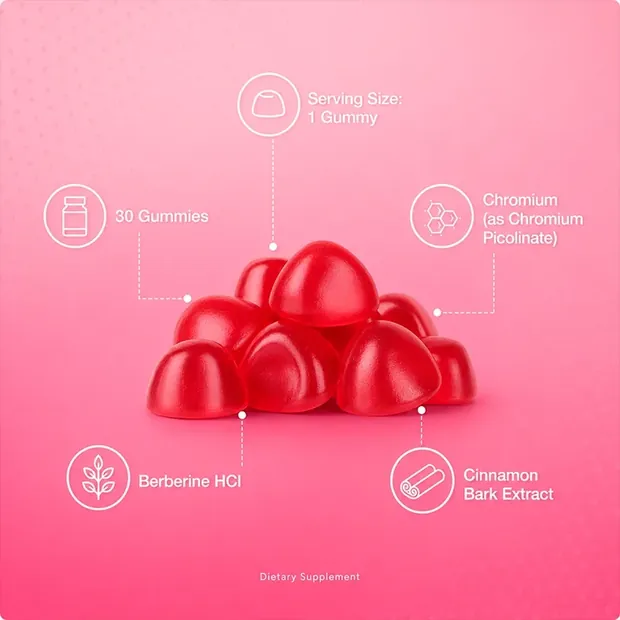
Each gummy has 0 calories and 1 g of total carbohydrate, according to the panel. The carbohydrate is less than 1% of the 275 g Daily Value.
US labeling rules allow any serving with fewer than 5 calories to be listed as zero. Maltitol and xylitol do carry some calories, but fewer than sugar. So think of the gummy as very low in calories.
The panel does not split the 1 g into sugar, sugar alcohol or fiber. Based on the ingredient list, most of it likely comes from maltitol, xylitol, pectin and rice flour.
- Calories
- 0 per gummy, as labeled
- Total carbohydrate
- 1 g per gummy (<1% DV)
- Sugar
- Not on the ingredient list
- Protein and fat
- Not listed on the panel
How do you read the Burn Gummy other ingredients line?
Label order is weight order, and that tells you a lot.
The other ingredients appear in order of weight, from most to least. So maltitol is the largest part of the gummy base and FD&C Red 40 is among the smallest.
That order tells you the gummy is mostly sugar alcohol by weight. It is a useful clue if sugar alcohols upset your stomach.
- Maltitol and xylitol: sugar alcohols for sweetness and bulk.
- Water, pectin and rice flour: the gel and texture.
- Citric acid and sodium citrate: tartness and acidity control.
- Acesulfame K and stevia leaf extract: zero-calorie sweeteners.
- Natural flavoring and coloring (FD&C Red 40): taste and color.
Large amounts of sugar alcohols can cause gas or loose stools (Lenhart & Chey, 2017). One gummy holds a small amount, but it is worth knowing if you are sensitive. Xylitol is also dangerous for dogs, so keep the bottle out of their reach.
What the Burn Gummy label does not tell you
A panel shows amounts. Some details sit outside its scope.
Cinnamon species
Ceylon or cassia is not named, and no extract ratio is given.
Maker and factory
The manufacturer name and factory address are not published on this site.
Lab testing
No independent lab certificate is published. The CoA number is a reference only.
Carb breakdown
The 1 g of carbohydrate is not split into sugar alcohols or fiber.
These gaps are common on supplement labels. They do not mean anything is wrong. They do mean some questions need a call to the order desk at +1 (855) 482-1597.
Tips for reading any label, including Burn Gummy
Six habits that make any Supplement Facts panel easier to judge.
Start with the serving size
Every amount on the panel is per serving. Here that is 1 gummy, so the math is simple.
Match units carefully
Chromium is in micrograms (mcg). Berberine and cinnamon are in milligrams (mg). One mg is 1,000 mcg.
Use %DV only where it exists
A high %DV means a small reference number was met, not that the dose matches research.
Compare weights with studies
For ** ingredients, compare the mg amount with the daily dose used in trials.
Read the other ingredients
Look for sugar alcohols, dyes or anything you avoid. They are listed by weight.
Record the lot
Note the lot from the bottle base and check it on the Burn Gummy batch check page.
Once you can read the panel, the next step is to use the gummy well. See how to take Burn Gummy for timing and storage tips.
Burn Gummy Supplement Facts questions
How many gummies are in a bottle of Burn Gummy?
Each bottle holds 30 gummies. The serving size is 1 gummy, so the panel lists 30 servings per container. That is a 30-day supply at the label dose.
Why does chromium show 71% Daily Value?
The Daily Value for chromium is 35 mcg. One gummy has 25 mcg, and 25 divided by 35 is about 71%. The number tells you how much of a day's reference amount one gummy covers.
What do the two asterisks mean on the Burn Gummy label?
The double asterisk means the FDA has not set a Daily Value for that ingredient. Berberine HCl and cinnamon bark extract both carry it. It is not a warning and not a quality mark.
Does Burn Gummy really have 0 calories?
The panel says 0. US labeling rules let a product round a serving under 5 calories down to zero. The sugar alcohols carry a few calories per gram, so a gummy is very low in calories rather than truly empty.
Is the 1 g of carbohydrate sugar?
Sugar is not on the ingredient list. The carbohydrate comes mostly from maltitol, xylitol, pectin and rice flour. The panel does not break the gram into sugar alcohols, fiber or starch.
Does the Supplement Facts panel prove what is in the gummy?
It is the maker's statement of contents, and it is the best source we have. It is not an independent lab test. The lot and CoA numbers on this site are reference numbers, not lab proof.
Can I take more than one gummy to raise the %DV?
No. The label says one gummy daily, and the panel math is built on that serving. More gummies also means more sugar alcohol, which can upset the stomach. Ask a doctor before changing any dose.
Where are the lot number and best-before date?
When the bottle shows them, they are printed on the base. Write them down when your order arrives. They help if you ever need to call about a bottle.
Ready to try Burn Gummy?
Order from the U.S. authorized merchant, keep your order email, and you are covered by the 60-day money-back guarantee. Questions first? Call +1 (855) 482-1597.
Keep reading
Ingredients
The three actives, eleven other ingredients and how each dose compares with research.
Read more →Batch check
What the lot and CoA numbers mean, plus eight checks for a genuine bottle.
Read more →How it works
What each ingredient is studied for, why fat burning is not shown, and the dose gap.
Read more →
